The question
Why does pigmentation return? Why do two people with “uneven tone” need different plans?
What is happening biologically?
Melanin sits in a living system. Sun, heat, inflammation, hormones, and barrier injury can all ask melanocytes to deliver more pigment. Sun damage, post-inflammatory marks, and melasma are related in the mirror and distinct in mechanism.
Melasma in particular can worsen with inflammation or injudicious procedures. A regenerative stimulus that helps texture on one patient can aggravate pigment in another. That is not a failure of “science-backed” branding. It is pigment biology.
What research has studied
How we use numbers. When a percentage or count appears here, it belongs to a named study with a named population. It is not a studio guarantee.
A 2020 systematic review of microneedling for melasma included eight studies. Most used needling to help deliver topical agents. Evidence quality was low; a meta-analysis was not possible. There is less support for needling as monotherapy. One ancillary observation was a relatively low risk of post-inflammatory hyperpigmentation in the reviewed work (Wu, Muddasani, and Alam, 2020). That is not a 70% intensity-reduction figure.
In pigmented acne scarring (Fitzpatrick III–V), a 39-patient series found significant improvement on a post-acne hyperpigmentation index without worsening of pigmentation (Al Qarqaz and Al-Yousef, 2018). That is scar-associated pigment, not a signed 60% PIH-clearance paper, and not a license to treat every melasma the same way.
Unsigned spa figures — “60% PIH reduction,” “greater than 70% reduced intensity” without a named trial we can open — stay off this page.
What this means in practice
Revive is our language for sun damage, uneven tone, hyperpigmentation, and melasma. Assessment looks at pattern, history, and inflammatory risk before any depth is chosen. Home care and sun behavior are not afterthoughts; they are part of the protocol.
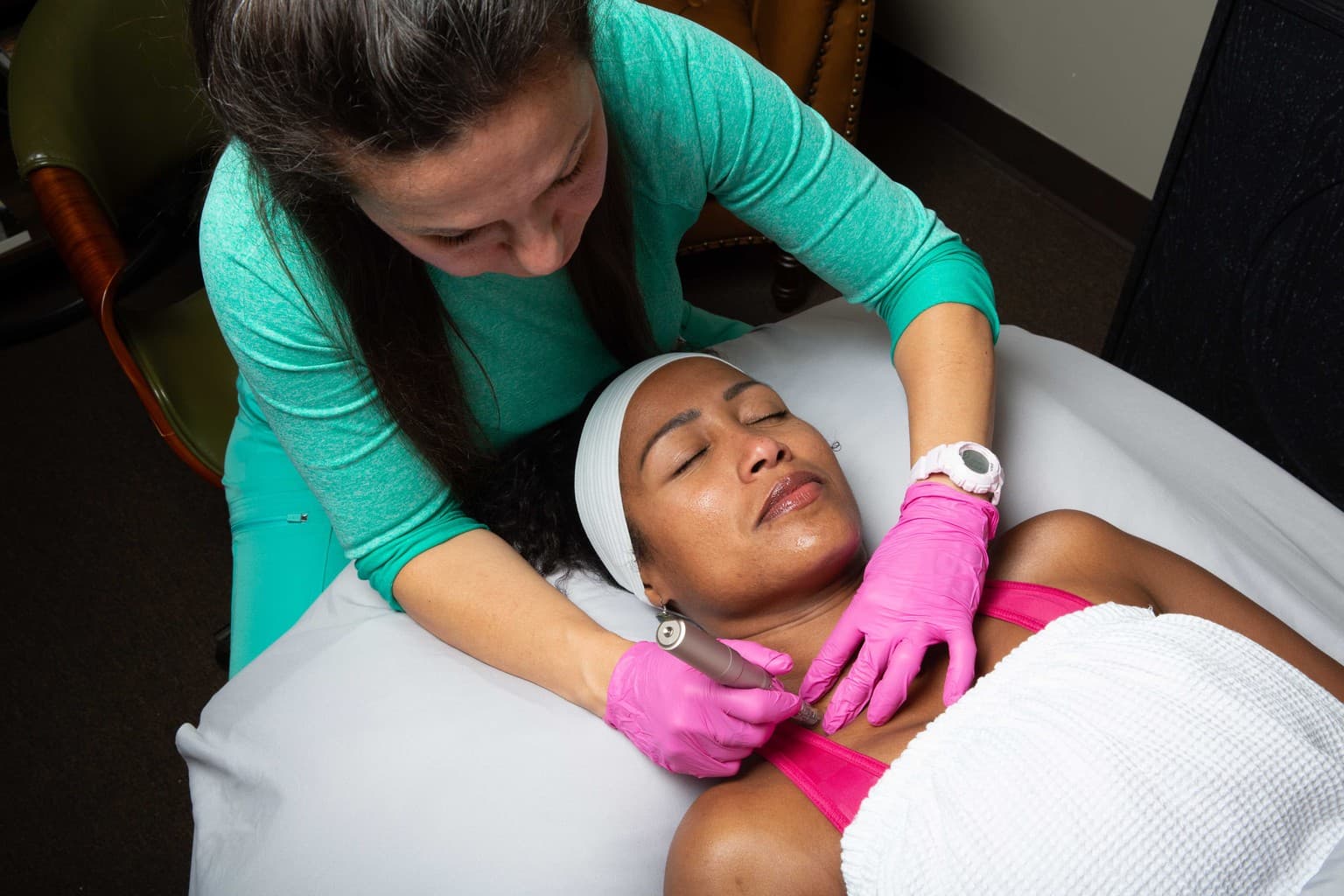
When needling belongs, it is often as one piece of a pigment plan — not as a promise to erase a patch. Photoprotection after a pass is non-negotiable in Virginia light.
Federica’s clinical perspective
I would rather delay a pass than chase a photograph that inflames pigment. Traditional and clinical training agree here: do not insult a system that is already reactive. When we do treat, we treat the person who has to live in the sun of Virginia, not a studio lighting setup.
The next step is not a retail booking. Begin with the Online Assessment so Federica can review what the skin is actually asking for. If this concern is yours, the Sun Damage + Pigmentation Pathway is where that conversation lives.
Educational only — not a substitute for personalized medical advice. Talk with a qualified clinician about your own care.
Visual explanation
Sun damage, post-inflammatory marks, and melasma can look similar and behave differently. Assessment reads pattern before any stimulus. We do not publish unsigned clearance percentages.
Last reviewed 2026-08-18 · Practitioner perspective