The question
How does the hair-growth cycle work — and what can a regenerative scalp plan actually support?
What is happening biologically?
Each follicle moves through a cycle. Textbook scalp ranges (Paus and Cotsarelis, 1999, and subsequent follicular biology) are:
- Anagen (growth) — typically two to six years on the scalp, sometimes longer. Most scalp follicles — often described around 85–90% — sit here at any time.
- Catagen (transition) — about two to three weeks.
- Telogen (rest) — about two to four months, not a few weeks.
- Exogen — the old shaft sheds. Daily loss of roughly 50–150 hairs can be physiologic.
Miniaturization is a different story: follicles producing finer, shorter hairs over successive cycles under genetic, hormonal, inflammatory, or metabolic pressure. Patterned androgenetic thinning, telogen effluvium, alopecia areata, traction, and scarring alopecias are not one diagnosis. The scalp microenvironment — sebum, inflammation, circulation, traction — changes what a follicle can do in the next cycle.
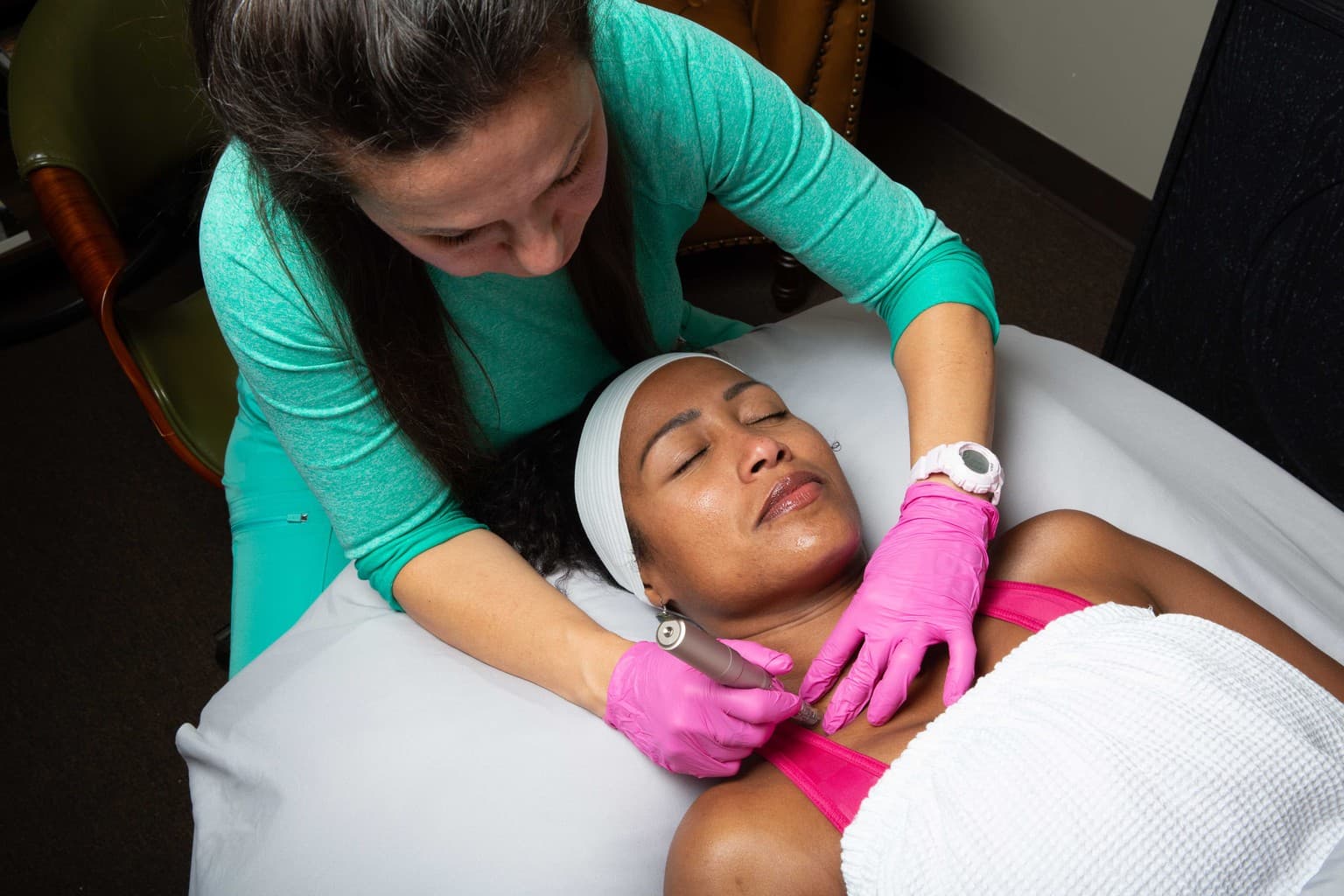
Microneedling on the scalp, when indicated, is studied as a way to support local signaling and topical delivery. It is not a transplant, and it is not a promise to reverse every pattern of loss.
What research has studied
How we use numbers. When a percentage or count appears here, it belongs to a named study with a named population. It is not a studio guarantee.
In men with mild-to-moderate androgenetic alopecia, a 12-week evaluator-blinded pilot compared weekly 1.5 mm rolling plus twice-daily 5% minoxidil with minoxidil alone. Mean hair-count change in a 1 cm² tattooed area was 91.4 versus 22.2. In the combination group, 82% reported more than 50% improvement versus 4.5% with minoxidil alone (Dhurat and colleagues, 2013, International Journal of Trichology). Marketing copy that cites “80% visible growth after 12 weeks, 2018” is almost certainly a mis-date of this 2013 paper. The finding is male AGA, one protocol, twelve weeks.
Faghihi and colleagues (2020) found that 0.6 mm plus minoxidil outperformed minoxidil alone on hair count and thickness over twelve weeks, and tended to outperform 1.2 mm on those measures — a reminder that deeper is not automatically better.
A 2021 regression synthesis reported that microneedling monotherapy was associated with a larger increase in total hair count than 5% minoxidil (β = 12.29), and that adding minoxidil to needling was associated with a further increase versus needling alone (β = 7.63) (Gupta and colleagues, 2021). Those are synthesis coefficients across limited, heterogeneous trials — not a predicted count for your scalp.
We do not present acupuncture-trial percentages as equivalent to these Western RCTs, and we do not copy unsigned “80% after 12 weeks” headlines from a year that paper was not published.
What this means in practice
Regrow is our language for scalp vitality: environment, cycle, and regenerative support when candidacy is sound. Light therapy or topicals may enter the protocol. Progress is tracked. Scope is confirmed clinically, including whether needling belongs at all.
If the pattern is advanced, scarring, or medically unexplained, assessment may point toward medical collaboration before any device conversation.
Federica’s clinical perspective
Hair carries identity. I treat that seriously without inflating what a Saturday can do. If the pattern is advanced, I say so. If the scalp is inflamed, we address environment first. If microneedling may help signaling, we place it inside a plan that can be followed for months, not a weekend.
The next step is not a retail booking. Begin with the Online Assessment so Federica can review what the skin is actually asking for. If this concern is yours, the Scalp Vitality Pathway is where that conversation lives.
Educational only — not a substitute for personalized medical advice. Talk with a qualified clinician about your own care.
Visual explanation
Most scalp follicles sit in anagen at any time. Daily shedding of roughly 50–150 hairs can be physiologic. Miniaturization — finer, shorter hairs — is a different conversation from a single shed. Durations are textbook ranges for scalp, not a diagnosis.
Visual explanation